In 1978, a grassroots art project called the East London Health Project was launched to raise public awareness around what campaigners saw as damaging cuts to the National Health Service in their area. Artists Loraine Leeson and Peter Dunn worked with a steering group consisting of members from health workers unions, the East London Trades Council, and the Tower Hamlets Health Campaign. In the last blog post, I reflected with Loraine and Peter on the origins of the project.
Nine posters were created over a two-year period which leant into the idea of a ‘visual pamphlet’. These were posters containing information that could be used in health centres, hospital waiting rooms or other community venues. They would later be collected by the Science Museum in 2007.
45 years after the project concluded, I caught up with Loraine and Peter to explore some of the posters created for the project and their impact.
‘Mental health is Class Conscious’
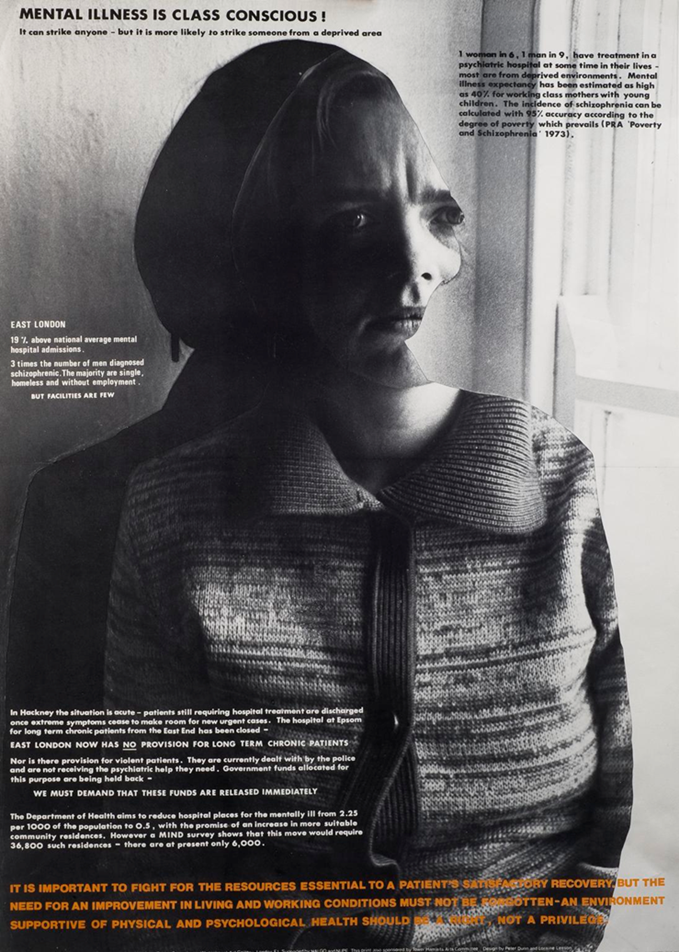
The subject of this poster is a woman with a furrowed brow looking quite distressed. Who was the person pictured?
Loraine: She was a friend of mine, remembering a time when she had felt depressed. It would have seemed intrusive to have pictured someone who was truly distressed. The offsetting of the image was a means of creating some of the disorientation implied.
What was understood about how class inequality could affect mental health outcomes?
Loraine: The knowledge that went into the information in these posters was that of the health professionals. The poster indicates inadequate living and working conditions, homelessness, and lack of health and support resources as adversely affecting people’s mental health – the relationship between poverty and mental health has become even more widely known in recent years.
In your opinion, how has the stigma associated with mental illness changed over the last 50 years?
Loraine: In my own experience the stigma has reduced somewhat in the sense that mental health is now talked about more freely. At the same time, however, the incidence seems to have increased significantly, especially amongst young people. Where I work in higher education it is now commonplace for a large proportion of students to be experiencing mental health issues – and they are amongst the more privileged in society.
‘Putting Quarts in Pint Pots’

In this poster, we can see people pouring out from a tap into overflowing pint glasses. Where did the inspiration for this poster come from?
Peter: The expression ‘putting quarts in pint pots’ has now become outdated. A quart was a much larger amount [than a pint] and the expression referred to trying to do the impossible by putting a larger amount into a smaller receptacle.
Trying to deal with a large number of people within a reducing health service – due to cuts, re-organisation, inflation, and privatisation by the back door – meant that lots of people would be marginalised and ‘spilled out’ of the system. I wanted to create an image that would catch the eye and raise curiosity which would then be answered in the text.
The text of the poster talks about class inequality and social deprivation. Can you tell us more about how socio-economic status affects access to healthcare?
Peter: Class inequality would mean that the richest and most privileged would gain access to services by jumping queues to NHS waiting lists via private consultations and the like. As capacity cannot be met, the private practices will erode NHS services, creating a two-tier system.
‘You can’t have it if you let them eat it’
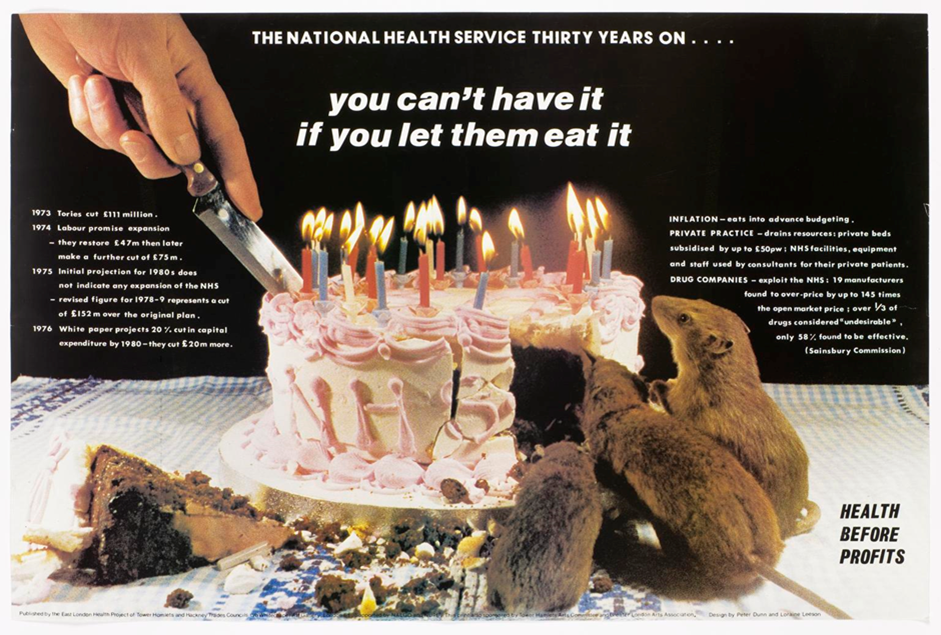
In this poster, there is a beautifully iced cake celebrating 30 years of the NHS, being feasted on by three rats. Can you talk us through the symbolism behind this and where this idea came from?
Peter: I really enjoyed working on this poster because the East London Health Project images were aimed to be put in doctors waiting rooms and hospital notice boards – a form of visual pamphlet rather than a poster – and because it was an ‘anniversary poster’, it should be in full colour.
So, I went to a local baker’s and had a cake made with the slogan on the side. I photographed it as a tableau with the knife cutting into one side, representing the cuts, and rats eating away at the other side to represent inflation and privatisation.
Were the rats hard to work with?
Peter: There is a story behind the rats. They were stuffed and I had planned to get them from a place I knew called Theatre Zoo. However, when I arrived, I was told there were no stuffed rats available in London because the Monty Python crew had commandeered them all!
I had to wait until they had finished before I could finish my shoot.
‘Passing the Buck’
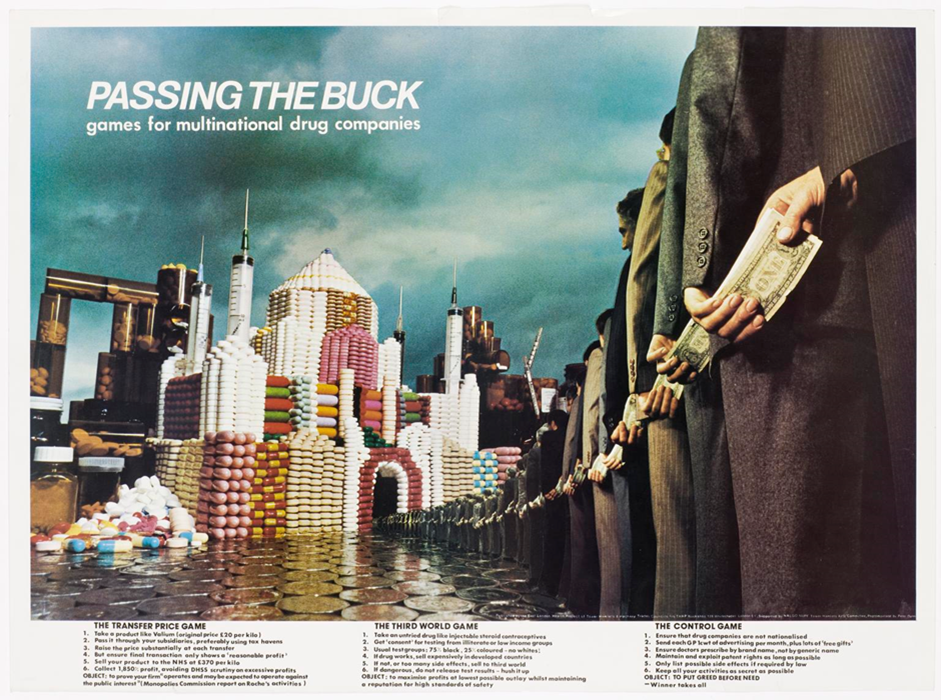
This poster depicts businessmen passing money down a line leading to a castle made of syringes and medications. It seems to critique the approach of multinational drug companies. What message were you trying to get across with this poster?
Peter: It was really about the strategies used by drug companies to market, sell, and test drugs, but it seemed a bit dry to be talking about strategies. I thought about referring to them as tricks that they play upon us but that didn’t seem right, so I came up with the idea of discussing them as ‘games’, which seemed to work when I put the different activities together under the final categories.
In addition to the poster, the Science Museum Group acquired the castle model made of pills into our collection. Where did the idea for the pill castle come from and how was it made?
Peter: It came out of thinking for something that could represent both the human body and an institutional body such as the NHS. The notion of the ‘body as a temple’ and how drugs were marketed as seductive, colourful, almost like sweets, [became] this idea of a kind of palace of pills.
I created the base structure using plastic foam used for packing, glued the pills onto the sides, adding hypodermics to the towers. I then made a ‘courtyard’ of 50p pieces which added a reflective element.

Reflections
If you were making this work in 2025, what would you include?
Peter: Successive governments have increased funding at the top-end, increasing bureaucracy and cost-centred reporting structures which gets in the way of delivering resources to where it is needed at the nurse/doctor/patient interface.
The hidden methods of creeping privatisation need further investigation because it is not always visible what these are – our task then was to try and make the invisible visible – this would be key to today’s investigation.
What are your thoughts about the NHS today after reflecting on these posters?
Loraine: If we thought it was in a bad state then – what about now? Nevertheless, it still survives for now and delivers excellent care, when you can get it.
Peter: It is sad to see that the progression of cuts and erosions have continued to take place and the COVID-19 crisis demonstrated how these factors have rendered the service a shadow of its former self.
It remains the dedication of the staff who work tirelessly – to keep the patients safe and treated as effectively as resources allow – that keeps it going.
Discover more about the origins of the East London Health project in our previous blog post, or read this deep-dive into the ‘women in health’ posters created as part of it.