While looking through the Science Museum’s Public Health & Hygiene collection, I came across a series of eye-catching posters made about the NHS for the East London Health Project. Immediately, I wanted to learn more.
The 1970s saw increasingly intense political debate about the NHS. The reforms proposed for the NHS resulted in many local hospitals facing closure. Growing unionisation and frustration over pay led to widespread strikes in the NHS, as in other areas of the economy. Waiting lists grew, as did awareness of class-based health inequalities.
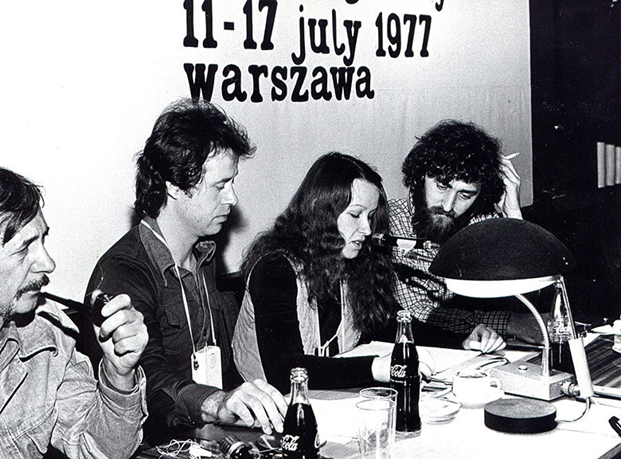
In 1978, a grassroots art project called the East London Health Project was launched to increase awareness of how these issues affected people in the local area. Artists Loraine Leeson and Peter Dunn worked with a steering group consisting of members from health workers unions, the East London Trades Council, and the Tower Hamlets Health Campaign. Nine posters were created over a two-year period and later collected by the Science Museum in 2007.
45 years after the project concluded, I caught up with Loraine and Peter to reflect on the project.
In the late 1970s, there was an increase in public campaigning addressing reforms to the NHS. Why did you get involved in this activism?
Peter: There were many reasons, some personal, some political and in response to what was going on the artworld at the time. Personally, I grew up on a council estate in Liverpool, my mother was a nurse as were two of my sisters.
When did you start to work together?
Loraine: I started working with Peter while we were both students. We wanted to find a way for our work to make a difference. Our first attempt to work outside of art institutions was a project about the development of two towns that we exhibited in libraries.
How did the East London Health Project come about?
Peter: The East London Health Project came out of the Bethnal Green Hospital campaign, funded by trades union (and trades council) support.
Loraine: While on a film fellowship funded by the Regional Arts Association, we were invited to make a video for the campaign to save Bethnal Green Hospital from closure. It was through doing this – then going on to produce posters for the campaign plus an exhibition explaining its purpose – that we came to understand the effectiveness of developing artwork in this way. This work seemed to have the purpose we were looking for.
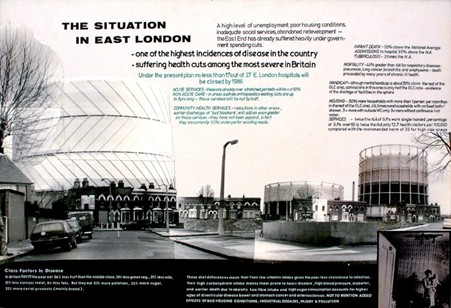
Loraine (continued): When that campaign was over, the activists decided to use its remaining funds to inform a wider public about the effects of the cuts to the NHS that were then becoming widespread. Seeing how well an arts approach had worked, they invited us to come up with a visual way of doing this with the help of a steering group.
We met regularly to determine a visual form that most suited to its potential audience. Together we arrived at the idea of the ‘visual pamphlet’ – essentially a poster containing information that could be used in health centres, hospital waiting rooms or other community venues.
This became known as the East London Health Project.
‘Health Cuts Can Kill’
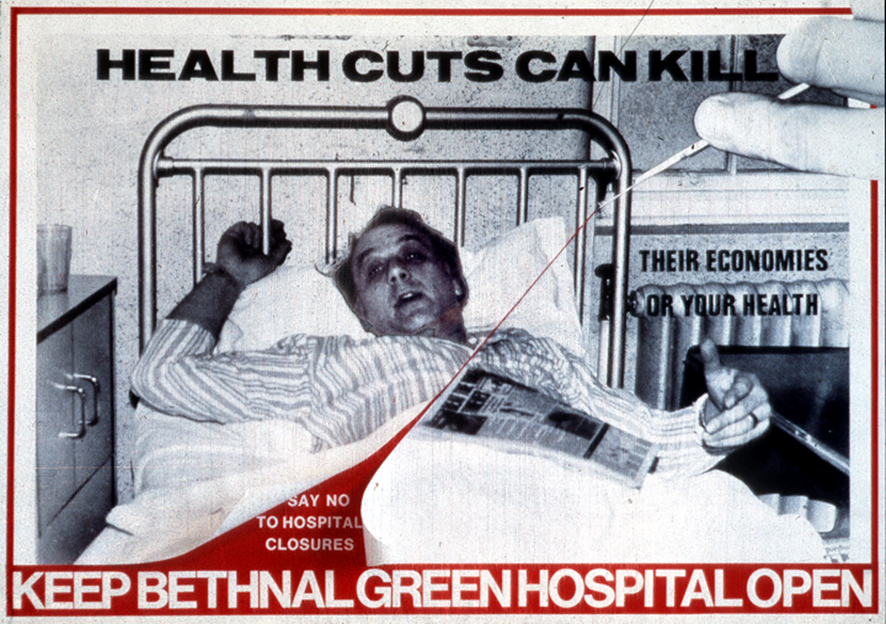
Tell me more about this poster which shows a hand with a scalpel cutting through an image of patient in a hospital bed, with the title ‘Health Cuts Can Kill’. How were health cuts affecting the local community in East London?
Loraine: This was the first poster produced for the campaign to save Bethnal Green Hospital. Under the first wave of cuts to the National Health Service, community hospitals were being closed, shifting health care to the already overstretched major teaching hospitals. Local people felt strongly about the important role of their community hospitals, where more personalised care could be offered for less critical cases.
A campaign committee was formed that comprised consultants, doctors and nurses, GPs, ambulance drivers and laundry workers. When the Regional Health Authority ‘closed’ the hospital, [the committee] put it into ‘occupation’. Legally, while there were patients in the hospital, there was an obligation to continue to employ the staff to look after them.
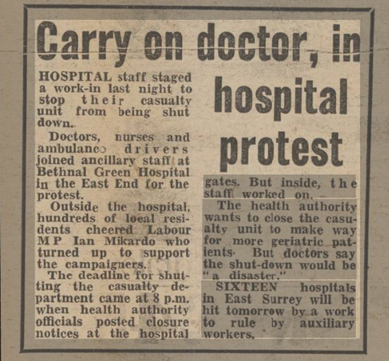
Peter: The campaign was run by the hospital staff, who had thrown out the management and were occupying the hospital. Ambulances kept taking patients there so it couldn’t be closed.
It was this hospital steering group that we became answerable to when producing the work.
Loraine:Since we were working with the campaigning staff of the hospital, they brought us into the hospital to gather material for the film and posters. A consultant introduced us to some patients who would be happy to share their views with us on the prospect of the hospital closure. The consultant also invited us into the operating theatre to film the removal of part of a colon – a memorable experience.
Peter: This man was a patient in the hospital. I asked one of the doctors if I could have a volunteer to put on the poster and I described the kind of effect I was aiming for. When I completed the artwork to my satisfaction, I took it back to [the volunteer patient] and he was delighted to be a part of the campaign to keep the hospital open.
Loraine:The posters for the [Bethnal Green Hospital] campaign, unlike those of the East London Health Project, were designed for fly posting and use on demonstrations. They therefore aimed to be visually arresting, rather than carrying any significant amount of information.
‘Behind the NHS’
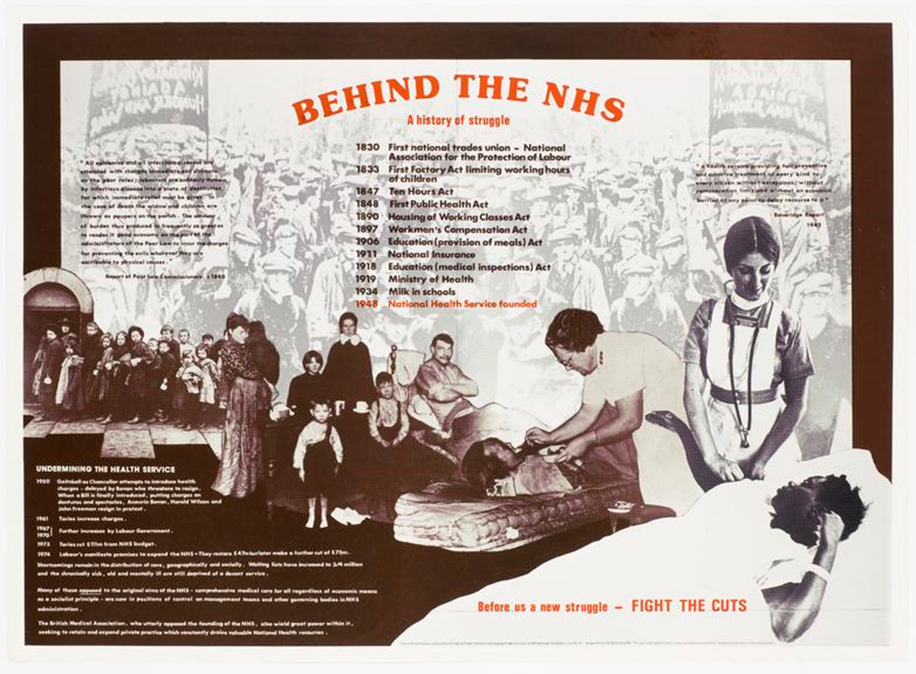
This poster has a rather historical angle, referencing labour and poor laws from the 1830s onwards. What was the thinking around the design and framing of this ‘Behind the NHS’ poster?
Loraine: The design of the poster was really a matter of how to fit in such a wealth of information in a way that remained readable and accessible.
Peter: This was essentially designed to put the creation of the NHS into a historical context and give a grounding for the other posters – that [the NHS] didn’t just appear but came out of a history of struggle.
Loraine: My memory is that the East London Health project steering group were keen to caution people not to take the NHS for granted.
The poster is a reminder that what we now enjoy (or even complain about) in terms of free healthcare was far from the norm for earlier generations. Our health service was won on the back of enormous suffering, determination, and struggle by ordinary people, so we should be careful about letting important parts of it go – what is cut cannot easily be reclaimed.
Discover more about other posters produced for the East London Health project in the next blog post, or read this deep-dive into the ‘women in health’ posters created as part of it.